

Hello Friends!
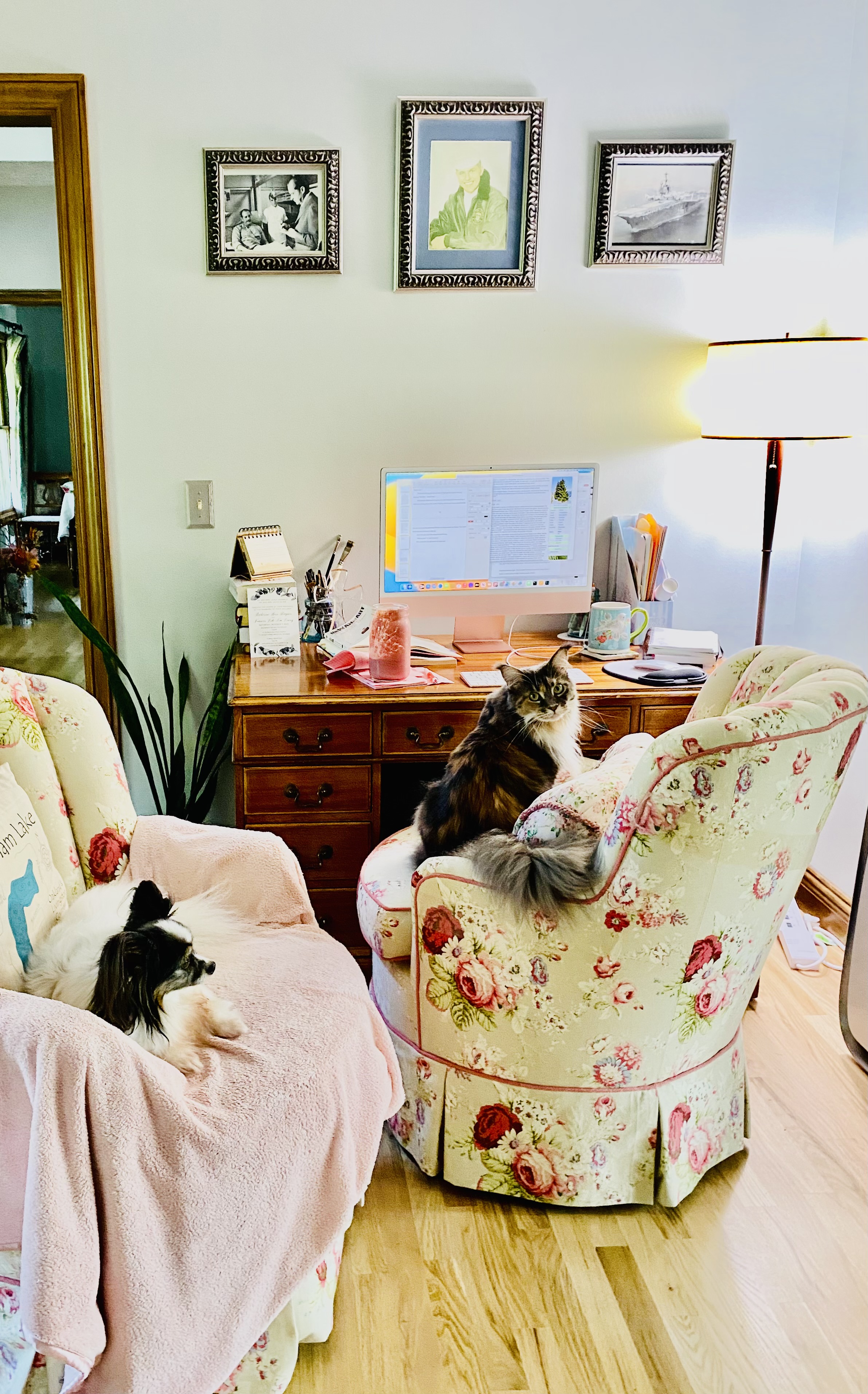
Since we are still in the getting-to-know-you phase, I thought you might like a peek behind the scenes. I usually start my day between 5:30 – 7:00 a.m. I sit at my desk and say, “Come Holy Spirit, renew a right spirit within me,” or, “Create in me a clean heart, O Lord.” Then, depending on if I’m in draft mode, I work from a chapter outline and allow inspiration to guide me. If I’m in research mode, I am either reading source material in books or online and then taking notes in my research files. I also build my world with various photographs depicting the characters, setting, history, and so on. As you can see, my assistants lounge beside me until I take a break around 9:00 a.m. to workout for an hour or more. When I return to work, this is usually what happens …
Then I continue for another hour or two before inspiration fades and I move on to other work. If I am singing for a funeral, I spend an hour rehearsing and praying for the family of the deceased and ask God to grant me His wisdom in planning my approach to the music requested. After sitting for so long, I try to remember to stretch by back over an exercise ball.
For those of you that sit at a desk all day, I highly recommend taking frequent breaks to stretch your spine in the opposite direction (extension). In upcoming posts I will share photos of exercises that I usually do to counteract the immobility of sitting at a desk. As with any new exercise, make sure you have your Doctor’s approval before you integrate anything I share. If any exercise hurts or aggravates an old injury, it is extremely important that you listen to your body and ease off and seek medical attention, when appropriate.
As for Pilates, let’s start at the very beginning with the basic principles. If you are visual, click on this article,(https://www.merrithew.com/docs/default-source/media/articles/what-is-pilates/download-a-brochure-on-the-stott-pilates-five-basic-principles.pdf,and you will have all the information you need.
The first principle in Pilates is breathing. Breath control oxygenates your blood and assists in your movement. Generally, we inhale through the nose on extension and exhale through the mouth on exertion/flexion of the spine. You will want to place your hands on your ribcage and breathe into your hands, feeling your ribcage expanding while you fill your lungs. On your exhale, you will breathe through your mouth as you feel your ribcage deflating and funneling down toward your waistline. Practice this technique a few times before you stand up from your desk and take a break.
The second principle is pelvic placement. For this exercise, it is best to be on your back with your knees bent and feet flat on an exercise mat in line with your hips, but you can also use your chair. If seated, snug your back against the chair and on your exhale, using your core muscles, tilt your pelvis backward until your low back (lumbar spine) is flat against the chair. Then, as you inhale, allow your pelvis to tilt slightly forward again. In the beginning, this is plenty of work, but in time, most students move forward to a neutral spine, which we can discuss at a later date. When working on your core muscles, remember to pull your navel toward your spine like you are pulling your tummy in to zip up a pair of skinny jeans. *It’s important to note, we all have unique shapes and sometimes the lumbar spine will not press flat. Be gentle with yourself and know that all exercises can be modified to meet your needs.
The third principle is rib cage placement. A great way to teach this is by lifting your arms overhead on an inhale, if you’re able. When you do this, you will notice how the ribcage fans outward. Now, slowly lower your arms on an exhale and feel your ribcage funneling downward toward your waistline. Your tummy muscles attach to your ribcage and provide support for your spine. It’s a good practice to use your tummy muscles when you lift your arms and when you extend your spine. When you attend a Pilates class, instructors will check your alignment for you to make sure when you’re flexing your spine forward that your ribcage is funneling downward and not outward.
The fourth principle is scapular movement and stabilization. We will repeat the same exercise of lifting our arms overhead, still in a seated position, if comfortable. On an inhale, try to lift your shoulders towards your ears as your fingertips reach for the ceiling. Then, on an exhale, slide your shoulders down away from your ears, feeling the back of your shoulder blades (scapula) glide into place on your ribcage. Now, lower your arms to reach in front of you and extend your reach as far forward as it is comfortable, feeling your shoulder blades separating (protracting). Then, slide your shoulders backward, feeling your shoulder blades returning (retracting) to their original placement along the spine. This exercise trains your shoulders to be in proper alignment and reduces tension in the neck and shoulders. The next time you feel neck strain, check where your shoulders are in space. Are they near your ears, like earrings?
Lastly, the fifth principle is head and cervical placement. A common posture for those of us working at a desk is for our chins to jut forward as we hunch our backs over our keyboards. Instead, sit up straight, place your finger on your chin and press backward until the space between your chin and chest can hold an orange. In a class, we would have you on your back, knees bent, feet flat on the mat, and arms along your sides. Then you would nod your chin toward your chest (inhale) as you flexed forward (exhale) reaching toward your toes, lifting your head and shoulders up from the mat. Hold for an inhale before slowly rolling back down on the exhale. This aligns your neck with your spine while in flexion.
To work on extension, you would roll on your tummy, elbows bent, hands by your shoulders, and legs open as wide as the mat, if comfortable. Then inhale (extension, remember) and press into your hands, keeping your chin slightly nodded (can’t hold an orange) as your chest lifts only until your bottom rib stays on the mat. If done correctly, you will feel length in the back of your neck as you extend your back. On your exhale, return to the mat. Ideally, if I was to check your spine in alignment, I could rest my forearm along your spine and neck without a huge gap or your head too far back. Please keep in mind, all these principles are mentioned throughout a Pilates class and it takes time to anchor them as habits. So in the coming week, just choose one to work on as you take a stretching break from your daily labor.
Fall is upon us, so in my next blog I will share a link to my favorite cider donut recipe along with my healthy swaps.
Blessings of health and joy to all of you this week!
Bree
 Bree Borkowski